- Blog
- News and Articles
Workholding saves time in production — why minutes matter more than you think
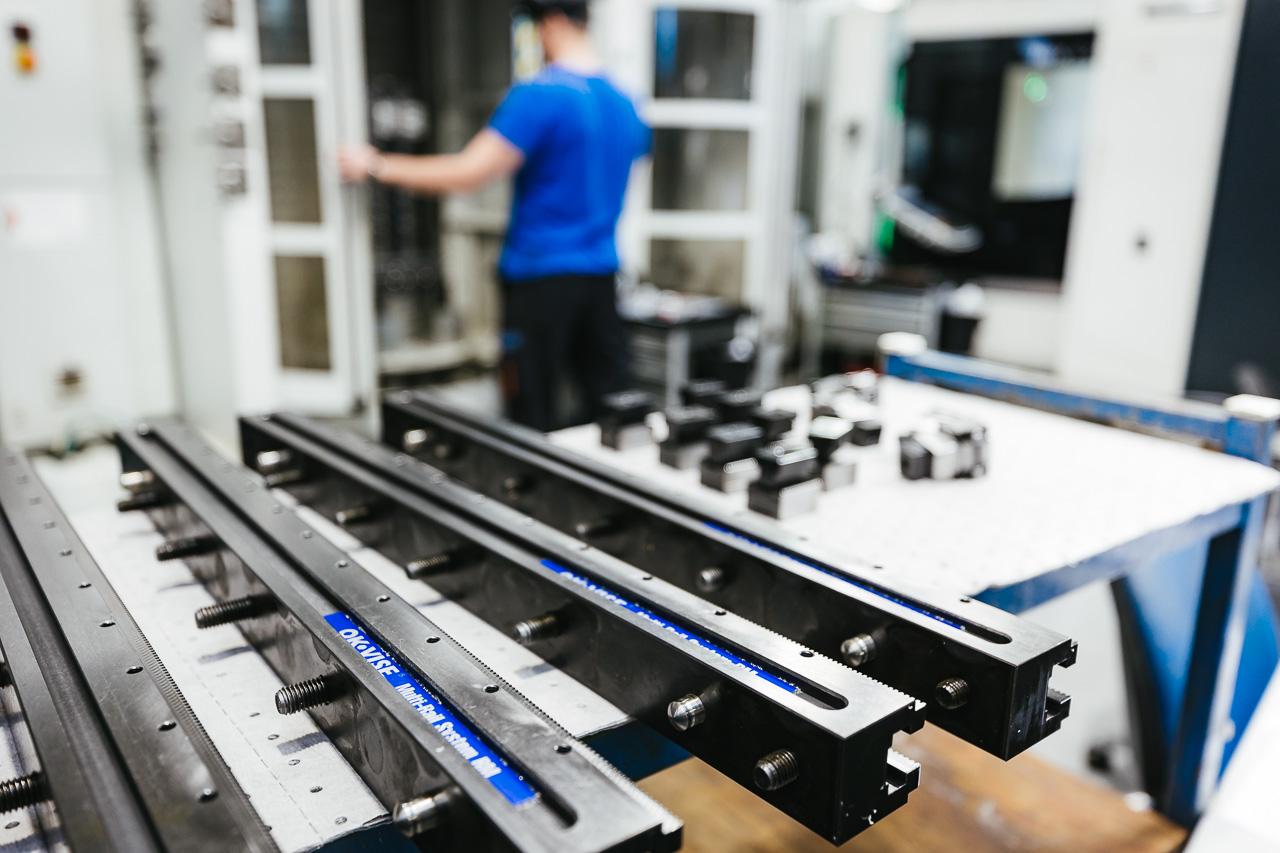
Key takeaways
- Setup time is a hidden production cost that directly reduces spindle utilization.
- Modern workholding solutions can significantly reduce changeover time.
- Small daily time savings create major annual financial impact.
- Standardized and modular fixturing improves production flexibility.
- Faster setups support automation, lean manufacturing, and scalable production.
Modern workholding has a major role in setup time
In CNC machining, productivity is often associated with cutting speeds, automation systems, or new machine investments. However, one of the most overlooked efficiency factors is far simpler: setup time.
Every minute spent aligning parts, adjusting fixtures, measuring positions, or changing setups is time when the spindle is not producing value.
As discussed in our earlier article about workholding as a productivity multiplier, efficient production capacity is not only defined by machines themselves, but by how effectively they are utilized. Workholding is a productivity multiplier — unlock more capacity without new machines
In high-mix manufacturing especially, setup efficiency can become one of the largest hidden bottlenecks in production. This is where modern workholding solutions play a major role.
Well-designed modular fixturing, quick-change systems, and standardized setups can dramatically reduce non-productive time while improving consistency across operations.
Why setup time matters more than many shops realize
In many machine shops, setup time is treated as unavoidable overhead. But from a production perspective, setup time is pure non-productive time. The machine consumes floor space, energy, labor, and capital — yet no parts are being produced.
Typical setup-related activities include:
- Fixture installation
- Workpiece alignment
- Jaw changes
- Edge finding and measuring
- Program verification
- Clamp adjustments
- Trial machining
Individually these tasks may seem small. Together, they can consume hours every week. This becomes particularly significant in:
- High-mix low-volume production
- Short production runs
- Frequent changeovers
- Prototype machining
- Flexible manufacturing environments
The shorter the production batch, the larger the relative impact of setup time becomes.
SMED thinking applies to machining too
Lean manufacturing introduced the concept of SMED (Single-Minute Exchange of Dies) to reduce setup and changeover times in production. The same thinking applies directly to CNC machining, where the objective is to minimize the time between the last good part of the previous job and the first good part of the next job.
Modern workholding systems support this by improving setup repeatability and reducing unnecessary manual work. Repeatable positioning, faster fixture changes, standardized setups, and predictable clamping locations help operators move from one job to another more efficiently and consistently.
When setups no longer need to be built from scratch every time, production becomes faster, more repeatable, and less dependent on individual operator experience.
Standardized modular workholding reduces complexity
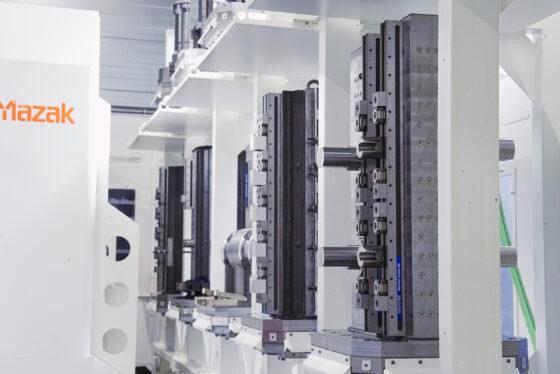
One of the largest hidden sources of setup inefficiency is variation. Different fixture concepts, inconsistent clamping methods, and non-standardized tooling layouts force operators to spend time solving the same problems repeatedly.
Standardized modular workholding reduces this complexity. Instead of dedicated fixtures for every part family, manufacturers can build flexible fixture platforms that adapt to different workpieces.
Examples include:
- Modular rail systems
- Zero-point systems
- Quick-change fixture plates
- Standardized locating principles
- Repeatable clamp modules
The operational advantage of workholding is significant. It means less measuring, faster setup validation, and easier documentation. Consequently, this reduces operator dependency and leads to a more predictable production flow.
Modern modular fixturing systems are increasingly replacing dedicated fixtures in flexible manufacturing environments because they improve adaptability without sacrificing repeatability. Modular fixturing for better flexibility and efficiency
Quick-change fixturing increases spindle hours
Every reduction in setup time directly increases available machining time. This becomes extremely valuable when machines already operate near capacity.
Quick-change fixturing systems help reduce:
- Fixture installation time
- Alignment work
- Measuring cycles
- Manual adjustments
- Setup variability
Zero-point systems are a strong example of this approach.

By allowing fixtures to be mounted repeatedly in accurate predefined positions, setup changes become significantly faster and more predictable. Combined with modular fixturing, quick-change systems create a production environment where setups are documented, repeatable, and scalable.
This is especially important when:
- Multiple operators use the same machines
- Production schedules change frequently
- Automation is introduced
- Night shifts or unmanned machining are used
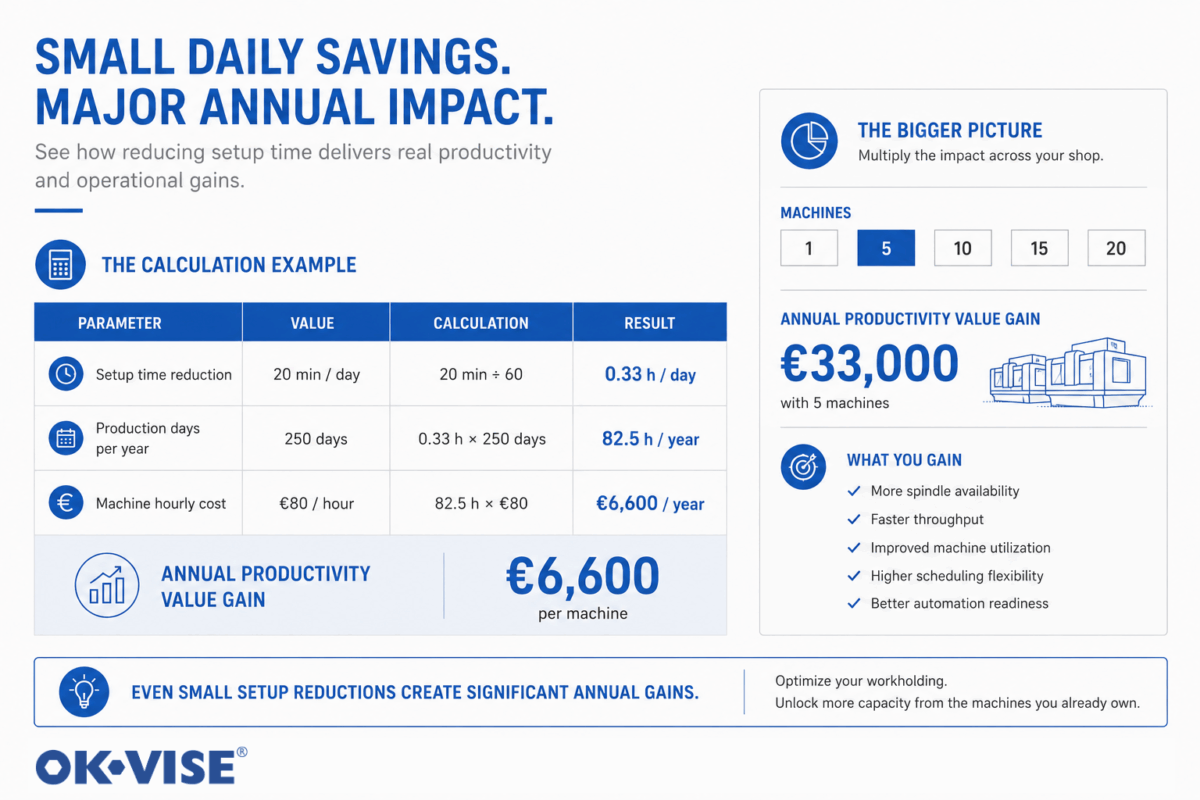
Example calculation — What 20 minutes per day really means
Small daily improvements often create surprisingly large annual impact. Let’s look at a simplified example of saved time using the right workholding solutions.
Assumptions
Setup time reduction: 20 minutes per day
Machine hourly cost: 80 €/hour
Production days per year: 250
Calculation
20 minutes/day = 0.33 hours/day
0.33 h × 250 days = 82.5 hours/year
82.5 h × 80 €/hour = 6,600 € annual productivity value
This example only considers a single machining center. In a production environment with multiple machines, frequent daily changeovers, and several operators, the cumulative impact quickly becomes substantial. More importantly, the gained spindle time often enables higher production capacity, shorter lead times, reduced overtime, and improved delivery reliability — without investing in additional machines.
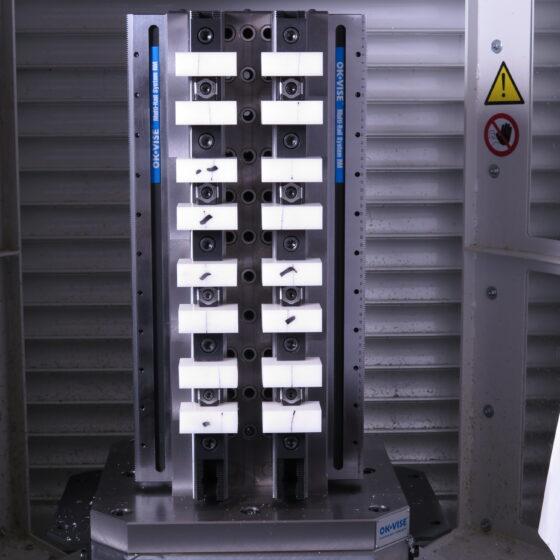
Multi-part fixturing extends unmanned machining time
Setup optimization is not only about reducing setup duration — it is also about reducing setup frequency.
Multi-part fixturing allows several workpieces to be machined in a single setup, extending cycle times and reducing the need for operator intervention between machining operations.
This improves machine utilization by enabling longer unattended machining cycles while reducing unnecessary workpiece handling and repetitive setup work. At the same time, production becomes less dependent on manual labor and more compatible with automation strategies such as pallet systems and robotic loading.
In modern machining environments, multi-part fixturing is often an important step toward more scalable and efficient production.
As modern manufacturing increasingly moves toward pallet automation, robotic loading, and flexible production systems, setup efficiency becomes even more critical. Reliable and repeatable workholding is often one of the enabling technologies behind successful automation implementation.
Setup efficiency also improves production flexibility
Production schedules rarely stay static. Urgent orders, changing priorities, and fluctuating batch sizes require manufacturers to adapt quickly. On the other hand, long and complex setups reduce responsiveness.
Fast and repeatable setup processes improve:
- Scheduling flexibility
- Production responsiveness
- Small-batch profitability
- Machine allocation flexibility
- Overall operational agility
In practice, this means manufacturers can react faster to customer needs without creating excessive production disruption. That flexibility increasingly becomes a competitive advantage.
Summary: Workholding is an important factor in reducing setup time
Setup time is often one of the largest hidden efficiency losses in machining production. While individual setup improvements may seem small, their cumulative operational and financial impact can be significant.
Modern workholding solutions help manufacturers increase spindle utilization, reduce non-productive time, as well as improve repeatability and simplify changeovers. Additionally, they support automation readiness and increase production flexibility.
In many cases, the fastest path to additional production capacity is not buying another machine — it is improving how efficiently existing machines are used.
FAQ
How much setup time reduction is realistically achievable?
The impact varies by production type, but even small reductions of 10–20 minutes per day can create meaningful annual productivity gains.
Are modular workholding systems suitable for high-precision machining?
Yes. Modern modular fixturing systems provide high repeatability and positioning accuracy while maintaining flexibility.
How do zero-point systems improve machining efficiency?
Zero-point systems reduce fixture installation and alignment time by enabling fast, repeatable positioning.
Is modular fixturing only beneficial for high-mix production?
No. While especially valuable in high-mix environments, modular systems also improve repeatability and setup consistency in serial production.
Does setup optimization support automation?
Absolutely. Reliable and repeatable workholding is essential for robotic loading, pallet automation, and unattended machining.
Ready to reduce unproductive production time?
Let’s evaluate the efficiency of your current workholding solutions and identify opportunities to reduce setup times and improve productivity.

OK-VISE
Contact Us
"*" indicates required fields


